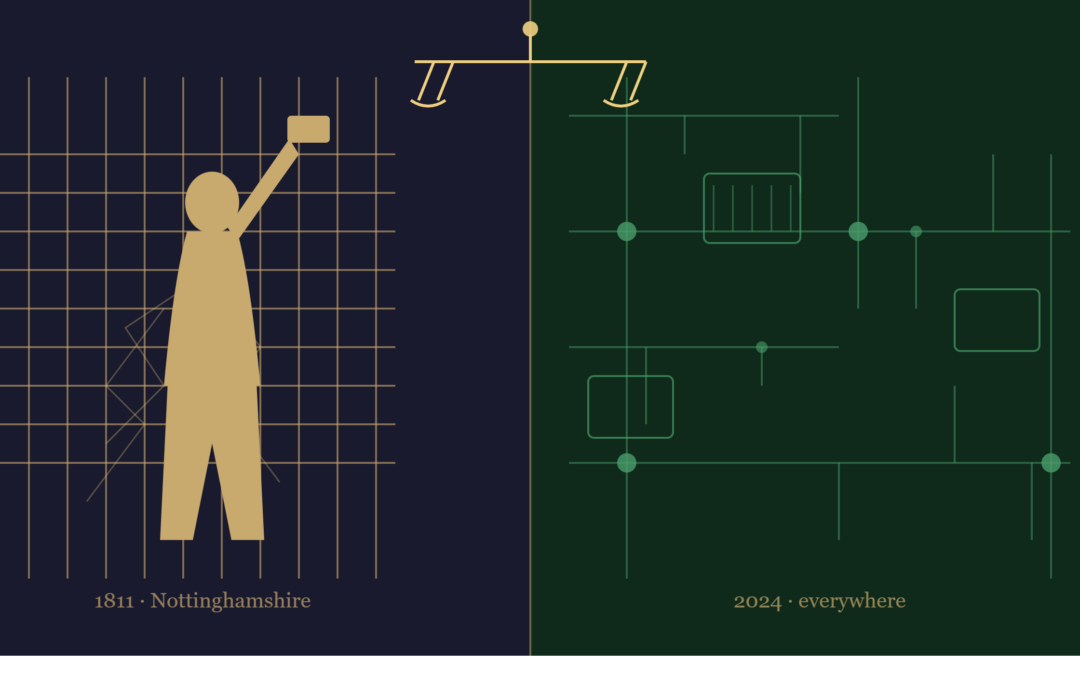
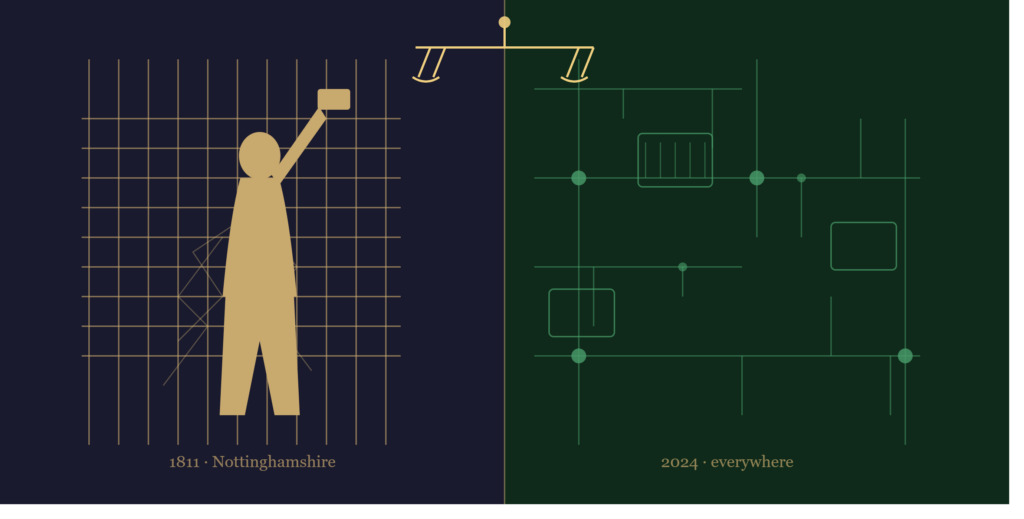
There is a word that has been unfairly used as an insult for over two hundred years. Luddite. Today it means someone who is irrationally afraid of technology, a reactionary who would rather smash progress than embrace it. This is historically wrong, and getting it wrong matters — because the same mistake is being made again right now about artificial intelligence.
In 1811, framework knitters in Nottinghamshire began destroying the new power looms that were flooding their trade with cheap, low-quality cloth. History remembers them as fools. What history tends to forget is that they were highly skilled craftsmen whose livelihoods were being destroyed by machinery that produced inferior work at a fraction of the cost, owned by men who had no intention of sharing the proceeds. They were not afraid of technology. They were afraid of poverty. They were right to be.
The Luddites lost, of course. The looms won. But the concerns they raised — about who benefits from technological change, about what happens to the people whose skills are made redundant, about whether cheaper always means better — those concerns were legitimate then and they are legitimate now.
The Looms of Our Time
Artificial intelligence is the power loom of 2026. The promises are extraordinary: tasks that took hours reduced to minutes, analysis performed at scale impossible for any human team, customer service available around the clock, documents drafted, images created, code written. The productivity gains are real. The cost savings are real.
And the concerns are also real.
Artists who spent years developing a distinctive style find it replicated in seconds. Writers whose work was used, without consent or compensation, to train the models now competing with them. Game developers, musicians, illustrators — a whole class of skilled creative workers watching their market compress in ways that feel, to them, exactly like what the framework knitters saw happening to theirs.
Calling these people Luddites is both lazy and unfair. Their concerns deserve engagement, not dismissal.
Where Accountants Come In
Our profession has taken to AI with considerable enthusiasm, and on the whole that is the right response. The tools available to accountants today — AI-assisted bookkeeping, automated transaction categorisation, intelligent VAT returns, real-time cash flow forecasting — genuinely improve the quality of service we can offer clients while reducing the drudgery of repetitive work. An accountant spending less time on data entry is an accountant spending more time on the advice that actually makes a difference to a business.
But enthusiasm without caution is where things go wrong.
I have seen AI used to draft client correspondence that contained confident errors. I have seen automated categorisation that misclassified expenses in ways that would have caused problems at a tax enquiry. I have seen reports generated at speed and sent without the review that would have caught the hallucination buried in paragraph three.
The problem is not that the AI is being used. The problem is that the professional judgment that should sit between the AI output and the client is being quietly skipped because the output looks so plausible, so complete, so confidently formatted.
An AI tool in accounting is exactly like a junior member of staff who works at extraordinary speed, never complains, and is occasionally and completely wrong without knowing it. You would not send a junior’s work to a client unreviewed. The same standard applies.
The Real Value — and the Real Danger
The genuine value of AI for businesses and their advisors lies in the space between the two failure modes. Not the Luddite position — refusing to engage because the technology feels threatening — and not the reckless position — trusting the output because the output looks trustworthy.
The real value lies in using AI to handle the high-volume, low-judgment work while preserving human attention for the high-judgment decisions that actually matter. Let the algorithm categorise five hundred transactions. Have a professional review the ones it flagged as uncertain. Let the AI draft the first version of the report. Have a professional read it before it goes anywhere.
This is not a compromise position. It is the only position that actually works.
What This Means for Your Business
If you are using AI tools in your business — and increasingly, whether you know it or not, you are — a few principles are worth holding onto.
Know what the tool is doing. AI that automates a process you do not understand is a liability, not an asset. If something goes wrong, you need to be able to explain it.
Keep a human in the loop for anything that matters. Customer communications, financial decisions, legal documents, anything that will be relied upon — these need a person to read them before they go out.
Do not assume that speed equals accuracy. The most dangerous thing about well-designed AI output is that it looks right. Plausible formatting is not the same as correct content.
And perhaps most importantly: the skills that AI cannot replicate — judgment, context, relationships, accountability — are exactly the skills that make professional advice worth paying for. The framework knitters were right that the looms would change everything. They were wrong to think that destroying the looms would stop it. The answer was never to smash the machines. It was to understand what the machines could and could not do, and to find the work that remained irreplaceable.
That work, for accountants, is considerable. And it is not going away.
Matthew Riley FMAAT is the principal of MR Associates, accountants and tax advisors based in Southam, Warwickshire. He has been helping businesses navigate change — technological and otherwise — for over thirty years.
Prepared with AI assistance.