
Back in March we asked whether you were ready for the April rollout of Making Tax Digital for Income Tax. The first quarterly deadline has now been and gone, so we can stop speculating about how it would go and look at what actually happened.
The short version is that a lot of people ignored it, and HMRC has decided to stop asking nicely.
The numbers
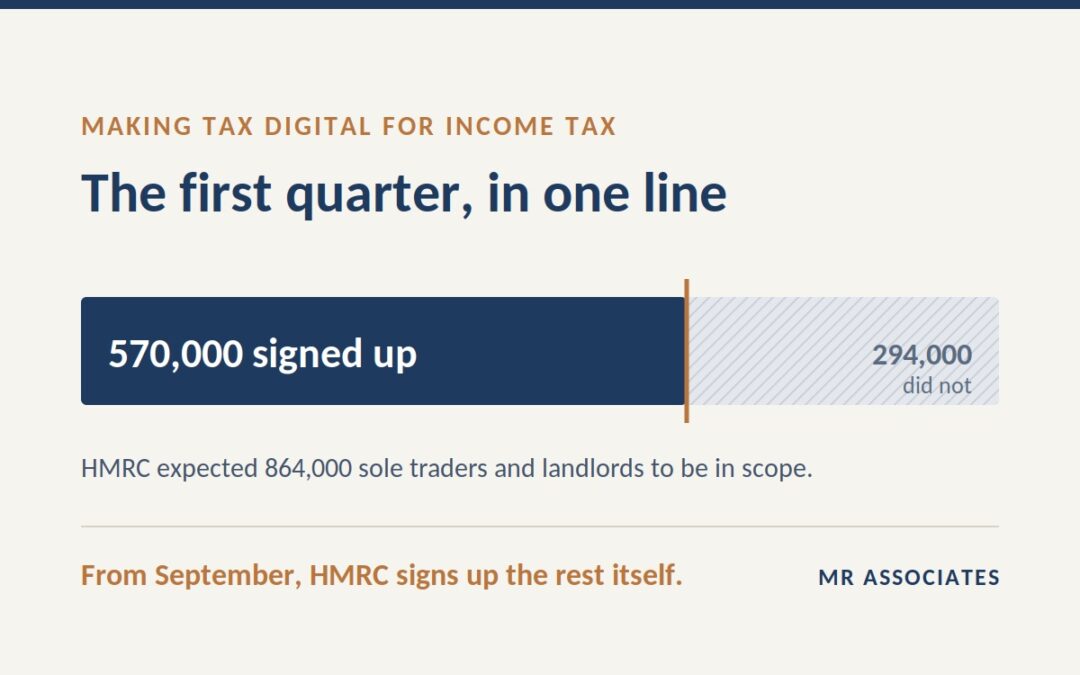
The first quarterly update covered 6 April to 5 July and was due by 7 August. HMRC expected around 864,000 sole traders and landlords to be in scope. By 12 August, just over 570,000 had signed up, and around 436,000 had actually filed on time.
That leaves close to 300,000 people who should have registered and have not, plus another 130,000 or so who registered and then let the deadline slide past.
What happens next
From September, HMRC will begin signing people up itself. If you are within scope and have not registered, you can expect a letter telling you the decision has been made for you. Guidance on what to do if one lands on your mat is due at the end of August.
At first glance this sounds almost helpful. One less job on the list. In practice it is the worst way to enter the system, for two reasons.
The first is software. Sign up in your own time and you can look at what is out there, work out what suits the way you actually keep your records, and compare the cost properly. Sign up because a letter arrived and you are choosing in a hurry, against a deadline someone else set.
The second is data. The automatic process works from what HMRC already holds, which means your earlier returns. If your circumstances have moved on since then, a property sold, a trade wound down, income that no longer looks the way it did two years ago, then what gets set up in your name may simply be wrong. Unpicking HMRC’s assumptions after the event is a good deal more trouble than getting it right at the outset.
Why so many people held back
The likeliest explanation is that there are no penalty points for missed quarterly updates during 2026/27. HMRC described this as a soft landing. A fair number of people seem to have read it as permission to wait and see.
That is understandable, but it only applies this year, and only to the quarters. Penalties for filing your tax return late and for paying late are unchanged. Quarterly updates do not replace the return, and 31 January has not moved. From 6 April 2027 the points system begins: one point for each missed quarterly deadline, and a £200 penalty once you reach four.
April 2027 also brings the threshold down from £50,000 to £30,000, which draws in a much larger group. Plenty of people watching all this from a comfortable distance this year will find themselves in it next year.
From this side of the desk
Having taken clients through a full quarter now, the filing itself is not the difficult part. Where the records are in order, an update takes minutes.
The work is all upstream. Businesses already keeping tidy digital records found the quarter fairly unremarkable. Those in the habit of handing over a carrier bag of receipts the following December found that the habit no longer fits, because the information now has to exist as you go along rather than being reassembled months after the fact.
That is the real change MTD brings, and we would argue it is a good one. Knowing roughly where you stand in August is a great deal more useful than finding out the following January, when there is nothing left to be done about it.
What we would not claim is that the plumbing is finished. You can report on the standard basis, 6 April to 5 July, or elect for calendar quarters running 1 April to 30 June. Where that election was changed, we have seen the system generate a hybrid period of 1 April to 5 July, which is not a period HMRC will accept. The update cannot be filed at all. At the time of writing it has not been put right.
This is where the letters come back into it. The basis has to be set correctly before the first update goes in, and once an update has been submitted it cannot be changed for the rest of the tax year. If HMRC signs you up automatically and sets that up from old data, you are locked into whatever it chose, and as we have found, the means of correcting it are not always there.
What to do now
The next quarterly deadline is 7 November.
If you are already signed up and filing, carry on. If you think you are in scope and have done nothing yet, register yourself rather than waiting for the letter. It takes very little time and it keeps the choices in your hands.
If you are not sure whether any of this applies to you, that is an easy question for us to answer. Give us a ring on 0333 880 1915 or drop us a line, and we will tell you where you stand.